
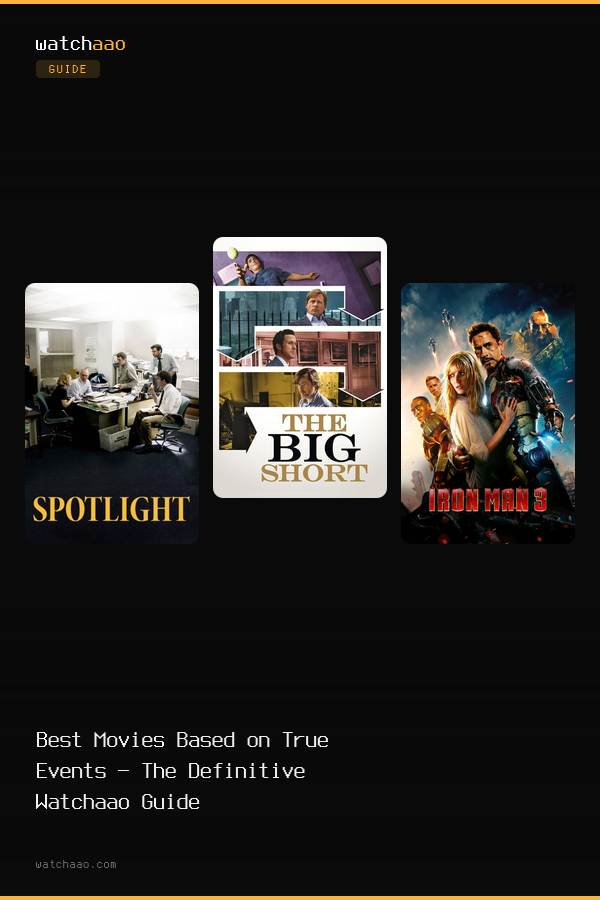
Most films that claim to be based on true events are using the truth as a marketing hook rather than a creative foundation. The films on this list are the exceptions — films where the real events are the reason the film was made, where staying close to what happened produces something better than invention would have, and where the ending you cannot change is more powerful than any ending you could write.
This ranking is ordered by how seriously each film takes the responsibility of the true story.
Watchaao Quick Decision
Want the best journalism film ever made? Spotlight.
Want something that makes financial systems comprehensible and genuinely enraging? The Big Short.
Want a procedural that refuses a tidy ending? Zodiac.
Want a well-crafted thriller that is also honest about its subject? Captain Phillips or Argo.
Want something about a single extraordinary human decision? Sully.
Spotlight (2015)
The Boston Globe's investigative team uncovers the Catholic Church's systematic cover-up of child sexual abuse by priests.
Tom McCarthy's film is the most morally serious on this list and the most restrained. It does not dramatise the abuse. It follows the reporting — the phone calls, the archive searches, the legal roadblocks, the moments when the scope of the investigation becomes clear to the people conducting it. The ensemble cast gives a collective performance of extraordinary precision. Spotlight won Best Picture because it demonstrated that the investigative procedural could be the highest form of the true-story film.
Watchaao verdict: The standard against which true-story films are now measured. The restraint is the achievement.
The Big Short (2015)
A small number of investors discover that the American housing market is built on fraud and bet against it. They are correct. The financial crisis of 2008 follows.
Adam McKay built an educational film that is also a moral indictment — one that explains credit default swaps using a celebrity in a bathtub and then reminds you that the people who got rich from understanding the fraud were not the heroes of the story. The formal inventiveness — fourth-wall breaks, explanatory cameos, title cards — is not gimmickry. It is the only honest way to make a film about systems that were designed to resist comprehension.
Watchaao verdict: The most formally innovative film on this list. A film that is genuinely angry and earns it.
Zodiac (2007)
David Fincher's procedural follows the San Francisco Chronicle's coverage of the Zodiac killer across two decades, and the cartoonist who became obsessed with the case long after the investigation stalled.
The true-story element here is the key to the film's power — Zodiac does not have a resolution because the real case did not have one. The film's 162 minutes of accumulation is not a flaw; it is a faithful representation of what following an unresolvable case for twenty years actually costs. Fincher shoots the period detail — the 1970s newsroom, the police coordination — with extraordinary care.
Watchaao verdict: The film on this list that takes the most from its true-story foundation. The lack of resolution is fidelity, not failure.
Captain Phillips (2013)
An American cargo ship is hijacked by Somali pirates. The captain attempts to protect his crew.
Paul Greengrass made a film that does not reduce the Somali pirates to villains. The decision to give Muse — their leader — a perspective and a context does not soften the threat; it deepens it, and the film's final sequence, in which Tom Hanks' performance reaches something genuinely overwhelming, depends on the moral complexity that preceded it. Captain Phillips is an action film that is honest about what action costs.
Watchaao verdict: The most balanced film on this list in terms of perspective. The final sequence is Tom Hanks at his best.
Argo (2012)
The CIA's plan to rescue six American diplomats hidden in the Canadian ambassador's residence in Tehran during the 1980 hostage crisis: fake a science-fiction film location scout.
Ben Affleck's film is the most purely entertaining on this list and the most honest about its entertainment — it builds tension through logistics and bureaucratic delay rather than action. The climactic airport sequence is conventional thriller filmmaking executed at a very high level. Argo does not inflate the danger beyond what the facts support, which is why it works.
Watchaao verdict: The most crowd-pleasing film on this list. A well-made thriller that takes its story seriously.
Sully (2016)
Captain Chesley Sullenberger lands a commercial aircraft on the Hudson River after both engines fail. The film is about what happens next.
Clint Eastwood made a film about the aftermath of a decision rather than the decision itself — the NTSB investigation, the hearings, the computer simulations arguing that Sullenberger should have returned to an airport. The choice to focus on institutional doubt rather than heroic action is correct. Tom Hanks carries the film's essential question: what does it cost to be told you were wrong about the most important moment of your life?
Watchaao verdict: The most unexpectedly affecting film on this list. A film about the bureaucratic experience of heroism.
Related Watchaao Collections
- Best Detective Movies — Zodiac in the context of investigation as subject.
- Best War Movies for Non-War-Movie Fans — Captain Phillips in the tradition of true-story films about real human cost.
- Movies That Are Safe Recommendations for Almost Everyone — Spotlight and Argo for broader recommendation contexts.


Community
Join the conversation
Native comments are planned for watchaao. For now, send your thoughts through the upcoming community channels.