

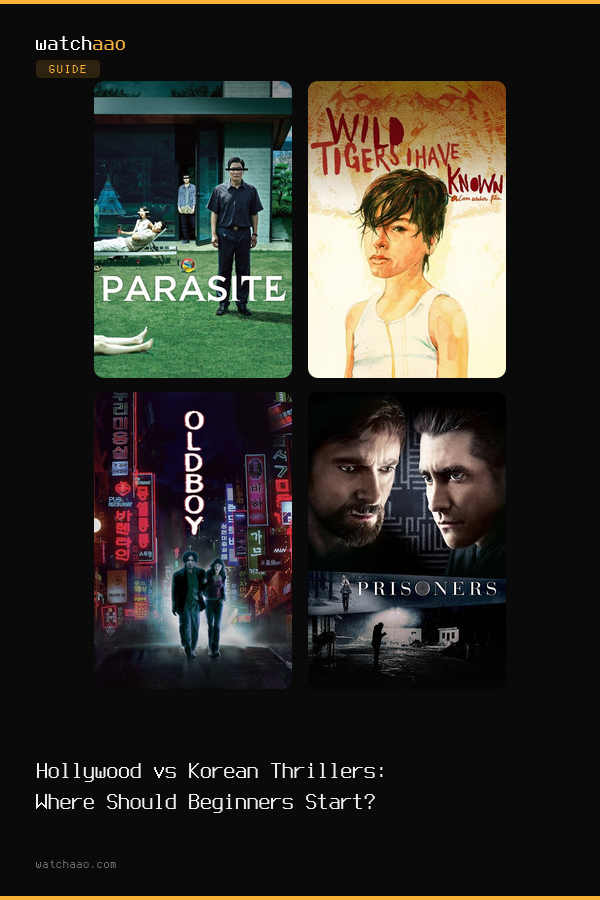
Most viewers who discover Korean thrillers arrive via Parasite or Squid Game, watch two or three more films, and then find themselves wanting to understand what they are actually responding to. This guide is for that moment.
The comparison between Hollywood and Korean thrillers is not about quality. Both traditions contain exceptional films and mediocre ones. It is about what each tradition prioritises — and understanding that difference helps you navigate both more efficiently.
What Hollywood Thrillers Do Well
Hollywood thrillers are structurally optimised for clarity and momentum. The genre conventions are established enough that audiences enter with shared expectations, which means a skilled director can subvert those conventions to create tension — or satisfy them to create satisfaction.
The best Hollywood thrillers — Se7en, Silence of the Lambs, No Country for Old Men, Prisoners — are technically precise, often cinematically conservative, and built around a single dominant narrative engine (the investigation, the escape, the chase). Character complexity exists but is usually in service of the plot rather than running parallel to it.
Hollywood crime films are also morally structured in predictable ways. Transgression is punished, or its lack of punishment is the dark thesis. The moral universe is legible even when the film is bleak.
What Korean Thrillers Do Differently
Korean thrillers are less interested in resolution than in accumulation. They build dread through context — social, economic, familial — rather than through narrative mechanics alone.
Bong Joon-ho's Memories of Murder is built around a real murder case that was never solved. The film ends without a solution — and the ending is devastating not despite this but because of it. A Hollywood film with this premise would typically manufacture resolution. Bong's film refuses to.
The other major difference is genre fluidity. Korean cinema does not respect genre boundaries the way Hollywood does. Parasite starts as a dark comedy, becomes a thriller, and ends as a tragedy, and each register is played completely straight. Oldboy begins as a revenge narrative and arrives somewhere that genre labels cannot contain. This hybridity is not inconsistency — it is a different understanding of what a film can hold.
Korean thrillers also take class, family structure, and social shame seriously as dramatic material in ways that Hollywood crime films rarely do. The violence in Korean cinema is often the product of systems, not individual evil.
Where to Start as a Beginner
If you responded to Parasite's social tension: Go to Memories of Murder next. Same director, smaller scale, purer investigation form. Then Burning (Lee Chang-dong) for the most formally precise Korean thriller of the past decade.
If you responded to Parasite's genre switching: Go to Oldboy for the most extreme version of this quality. Then The Wailing for a film that moves through horror, thriller, and metaphysical investigation as if those are the same thing.
If you want to understand Korean thrillers through a Hollywood lens: Start with I Saw the Devil, which uses a familiar Hollywood setup — detective hunts a killer — and then dismantles it systematically. The film is about what happens after the premise of a Hollywood thriller resolves.
If you want Hollywood thrillers that approach Korean intensity: Prisoners is the closest American film to the Korean thriller tradition. Zodiac shares Korean cinema's comfort with accumulation and unresolved dread.
The Decision
Neither tradition is more sophisticated than the other. They are solving different problems.
Hollywood thrillers are better when you want narrative satisfaction — a complete architecture with a beginning and an end. Korean thrillers are better when you want a film that stays in your body after the credits — that creates feelings the narrative does not fully explain or release.
Both are worth knowing.
Related Watchaao Collections
- Best Korean Thriller Movies — the essential Korean thriller canon.
- One Night Watchlist for Thriller Fans — a curated single-night plan across both traditions.
- Movies That Will Mess With Your Mind — the films that share Korean cinema's quality of refusing to let go.









Community
Join the conversation
Native comments are planned for watchaao. For now, send your thoughts through the upcoming community channels.