

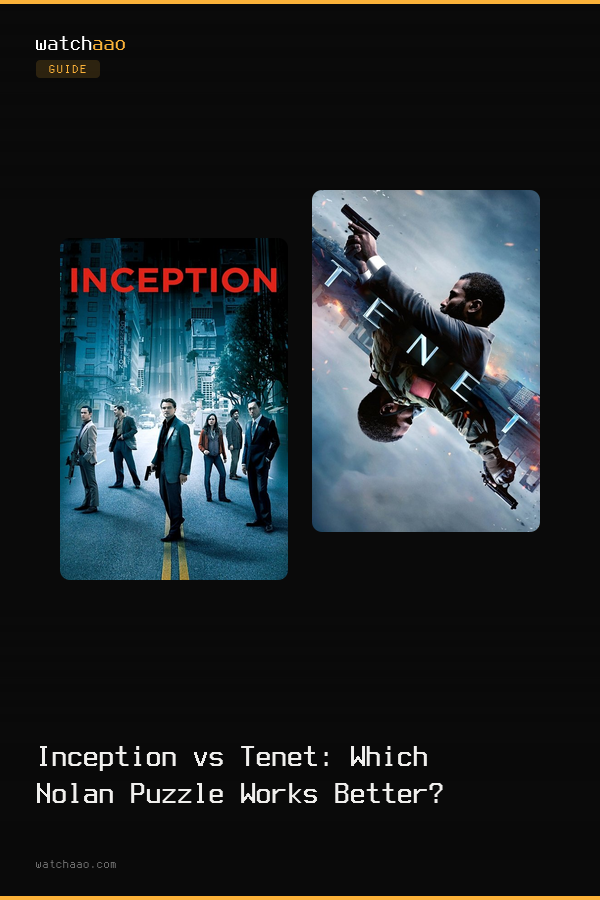
Christopher Nolan made two films that use structural complexity as their primary cinematic language. In Inception, the structure is the story. In Tenet, the structure is the obstacle. That difference explains everything about why one of them works and the other one strains.
This is Watchaao's comparison of Inception and Tenet.
The Short Answer
Inception works. Tenet does not work as well.
This is not a majority opinion — Nolan has defenders for both. But the reasons one succeeds where the other falls short are structural and specific, and they are worth understanding before you decide which to watch first.
What Inception Actually Is
A thief who specialises in extracting secrets from dreams is hired to plant an idea instead. He assembles a team, builds a plan, enters three levels of dreaming simultaneously, and the film runs all three levels in parallel for its final act.
The genius of Inception is that its complexity is always in service of its emotional core. Cobb's refusal to let go of Mal — the projection of his dead wife — is the thing that jeopardises every level of the mission, and that threat is comprehensible without any understanding of the film's dream physics. The spectacle and the feeling are unified. You can follow the film by following Cobb's grief even if you lose track of the logic.
What makes it exceptional: The four-level parallel editing in the third act is one of the great technical sequences in modern cinema. More importantly, the spinning top in the final frame is not a plot question — it is the correct emotional conclusion to a film about a man who does not want to know whether he is dreaming.
Runtime: 148 minutes.
What Tenet Actually Is
A CIA operative called the Protagonist is recruited into an organisation that uses time inversion — objects and people that move backward through time — to prevent a future catastrophe.
Tenet is technically extraordinary. The action sequences involving forward and inverted subjects are genuinely unprecedented. Ludwig Goransson's score is one of the best Nolan has had. And the plot, when fully mapped out, is internally consistent.
Where it falls short: The emotional centre is missing. The Protagonist has no interiority — he is a function, not a person. The film prioritises explaining its mechanics to the audience through rapid dialogue, which means characters often speak exposition rather than thought. By the time the structure reveals its shape, you understand it intellectually but have not felt it. Inception earns its final frame. Tenet earns its diagram.
Runtime: 150 minutes.
The Core Difference
Inception hides an emotional story inside its structure. Tenet hides the structure inside its structure.
Both are puzzles. One gives you a reason to solve it beyond the pleasure of solving it. The other relies on that pleasure alone, and for some viewers that is enough. For most, it is not quite sufficient for a film this demanding.
Watchaao Verdict
Watch Inception first — regardless of which you end up preferring. It is the more accessible film, the more emotionally complete film, and it establishes the kind of structural ambition Tenet pushes further.
Watch Inception if: You want a puzzle film that also makes you feel something. You want the structure to serve the story.
Watch Tenet if: You have already seen Inception and want to see Nolan push his formal ambitions beyond what the emotional framework can contain. You are interested in the problem of time inversion as a physical and cinematic phenomenon regardless of how you feel about the characters inside it.
Watch both and decide whether the ambition justifies the trade-off. Reasonable people land on different sides of this argument.
Related Watchaao Collections
- Best Mind-Bending Movies Ever Made — Inception appears alongside the tradition it belongs to.
- Interstellar vs Arrival: Which Is Better for a First-Time Viewer? — Nolan's other structurally ambitious sci-fi film, compared to its best peer.
- Movies Like Interstellar — for when both Nolan puzzles leave you wanting more.







Community
Join the conversation
Native comments are planned for watchaao. For now, send your thoughts through the upcoming community channels.