
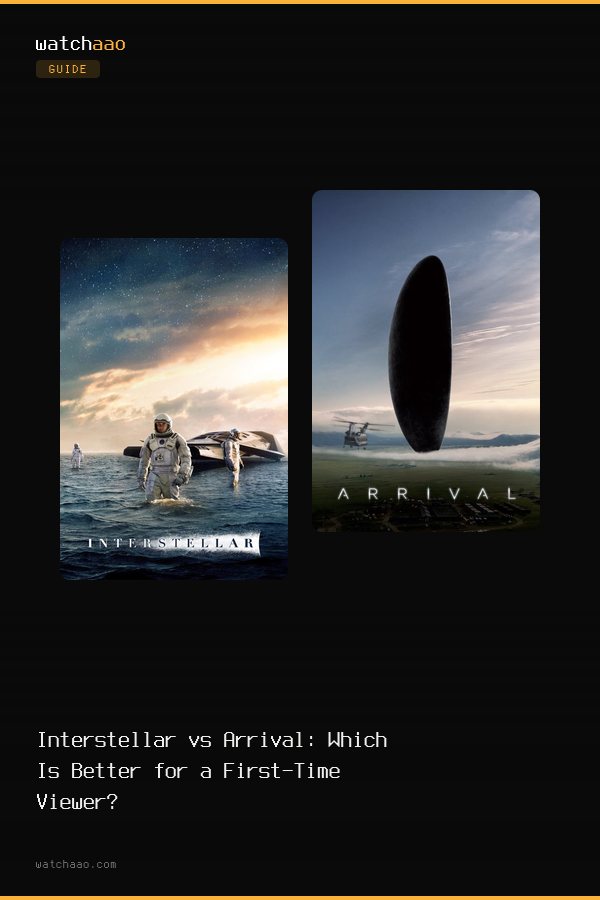
Both films deal with time. Both films deal with a parent's love for a child. Both films are made by directors who take science-fiction seriously as a philosophical medium. They are not the same film, and the differences between them tell you exactly which one to watch first.
This is Watchaao's comparison of Interstellar and Arrival for a first-time viewer.
The Short Answer
Start with Arrival.
Watch Interstellar second. If you start with Interstellar's scale and Nolan's emotional maximalism, Arrival's quietness may read as restraint. In the correct order, Arrival's precision makes Interstellar's ambition feel earned rather than overwhelming.
What Interstellar Actually Is
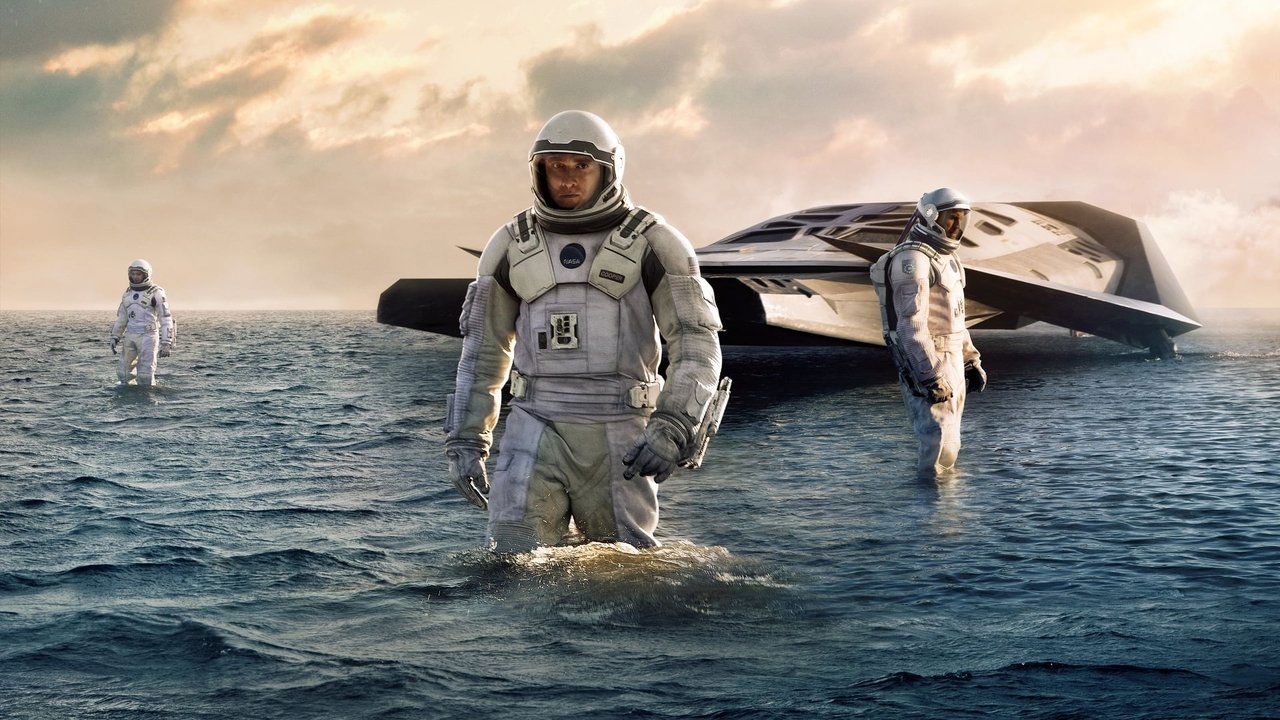
Christopher Nolan's 2014 film is a space opera about a father who leaves Earth to find a planet that can sustain human life, knowing he may never return to his daughter. It is enormous in every dimension — scope, runtime, emotional volume, scientific ambition — and Hans Zimmer's score ensures you feel all of it.
What it does exceptionally: The love between Cooper and Murph is the emotional spine of a film that is also genuinely curious about relativity, black holes, and the physics of time dilation. Nolan commits to the science enough that the emotional payoff in the third act hits as hard as it does. The docking sequence is one of the most technically extraordinary pieces of editing in modern cinema.
Where it strains: The third act requires the audience to accept a metaphorical interpretation of physics that the rest of the film's rigour does not entirely support. For first-time viewers, this can land either as transcendent or as a betrayal, depending on where their threshold sits. Interstellar demands emotional surrender, not just intellectual engagement.
Runtime: 169 minutes.
What Arrival Actually Is
Denis Villeneuve's 2016 film is about a linguist brought in to communicate with alien spacecraft. It is not about alien contact. It is about time, perception, and the question of whether you would choose love if you knew in advance what it would cost you.
What it does exceptionally: Arrival constructs its reveal not as a twist but as a structural clarification — the film tells you everything at the start and lets you understand it at the end. Amy Adams gives a performance of extraordinary containment; everything the film is about is present in her face long before the audience has the language to read it. The film is quiet, precise, and emotionally devastating in a way that does not announce itself.
Where it is different from Interstellar: Arrival is philosophical where Interstellar is emotional. It asks you to think alongside it, not to feel alongside it — though by the end the feeling arrives with complete force. It is the more formally elegant film.
Runtime: 116 minutes.
The Core Difference
Interstellar is a film about love as a force — literal, cosmological, the thing that pulls you across dimensions. Arrival is a film about love as a choice made with full knowledge of what it will cost.
One overwhelms. The other accumulates.
For a first-time viewer encountering both, Arrival teaches you how to watch this kind of science-fiction. Interstellar then pays off that education with everything it has.
Watchaao Verdict
Watch Arrival first. It is shorter, more precisely constructed, and it prepares you to receive what Interstellar is doing with its emotional scale.
Watch Arrival if: You want a science-fiction film that operates through accumulation and reveal. You are comfortable with quiet films that earn their devastation slowly.
Watch Interstellar if: You want cinema as an overwhelming experience. You are willing to accept that the third act requires emotional surrender over strict logical consistency.
Watch both the same weekend — in order — and the second film recontextualises the first in ways that make both of them richer.
Related Watchaao Collections
- Movies Like Interstellar — for when either film leaves you needing more science fiction with this level of ambition.
- Best Mind-Bending Movies Ever Made — both films appear, alongside the tradition they belong to.
- Best Sci-Fi Movies on OTT — where to find both films and what to watch next.





Community
Join the conversation
Native comments are planned for watchaao. For now, send your thoughts through the upcoming community channels.