
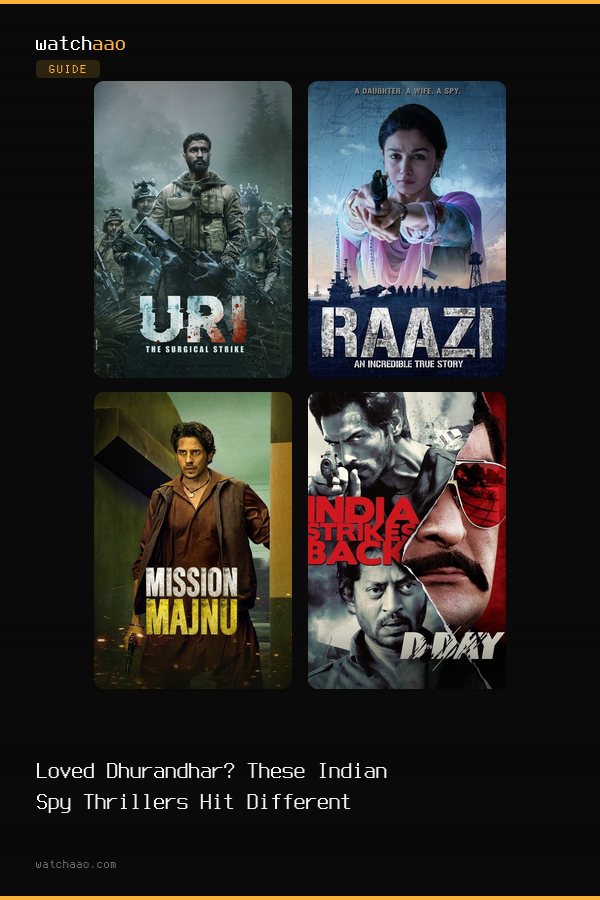
Dhurandhar did something rare. It did not just perform well at the box office — it brought people back to theatres who had stopped going. In a post-COVID landscape where OTT had become the default, this film made the case for the big screen again. Packed shows, soundtrack on loop, group chats full of recommendations. That is not just a hit. That is a cultural reset.
Streaming Matrix
Where to Watch These Indian Spy Thrillers
Compare current streaming availability for the Dhurandhar companion picks in your selected region.
 Raazi2018 / 138m
 Included
 Included
 RentBuy
 Mission Majnu2023 / 129mIncluded
 D-Day2013 / 153mRentBuy
 Ads
Ads Baby2015 / 160mRentBuy
 Agent Vinod2012 / 157mRentBuy
 Vishwaroopam2013 / 147m
 Phantom2015 / 136m
 Bell Bottom2021 / 123mIncluded
 Ek Tha Tiger2012 / 133mIncludedRentBuy
 Khufiya2023 / 158mIncluded
And when a film lands that hard, the brain immediately asks the obvious question: what else is there? Same tension, same intelligence, same feeling of watching something that takes the genre seriously.
This list answers that question. Eleven Indian spy thrillers — not ranked, not reviewed, not debated. Organised by one thing: the specific feeling each film shares with Dhurandhar, and when to watch it relative to Aditya Dhar's film to get the most out of both.
No spoilers. No box office numbers. Just the right film, in the right order, with the reason.
Before Dhurandhar: Build the Context
Uri: The Surgical Strike (2019)
Watch this first if you want Dhurandhar to land with more weight.
Uri and Dhurandhar share the same director — Aditya Dhar — and more than that, they share the same filmmaking grammar. The precision, the restraint, the refusal to make military operations feel romantic or patriotism feel like a sermon. Every emotional beat in Uri has a cost behind it, and every tactical move has planning behind it.
If you felt a specific kind of controlled intensity in Dhurandhar — a tension that never tips into melodrama — its roots are in Uri. Watching Uri first means you arrive at Dhurandhar already tuned to how this director thinks. You will notice the evolution, the places where Dhar pushed further, the choices that are deliberate callbacks.
Best for: Anyone who wants to understand Aditya Dhar's sensibility as a filmmaker, not just as a single film.
Watch it before Dhurandhar if: You want to see how a director's vision develops across films — not just what he made, but where he came from.
Raazi (2018)
The closest emotional companion to Dhurandhar on this list — and the right film to watch first.
Raazi asks the same central question that runs underneath Dhurandhar: when you become part of someone's life in order to betray them, what happens to your own identity? Alia Bhatt's Sehmat lives inside a Pakistani military family, genuinely connects with them, and that connection is simultaneously her most effective tool and her deepest wound.
The loneliness of that double life, the weight of carrying a cover identity — Raazi operates in the same emotional register as Dhurandhar, but in a quieter key and from a female perspective. If Dhurandhar's psychological cost stayed with you more than its action sequences, Raazi is the film that takes that specific feeling seriously and gives it room to breathe.
Best for: Viewers who want to arrive at Dhurandhar already emotionally calibrated to what undercover work actually costs.
Watch it before Dhurandhar if: You want to be tuned to the emotional frequency that Aditya Dhar's film demands before the film demands it.
Mission Majnu (2023)
Structurally the most similar film to Dhurandhar on this entire list.
RAW agent. Undercover in Pakistan. A marriage maintained as cover — to a Pakistani woman who has no idea. And when that cover relationship starts to feel genuine, the agent's real conflict begins — not with the enemy, but with himself.
Sidharth Malhotra plays this quietly and specifically, without heroic monologues. Just a man living two lives and slowly losing his footing in both. The moral burden of the cover identity — not as a tactical tool but as something you are actually living — is exactly what makes Mission Majnu feel like a companion to Dhurandhar rather than a lesser version of the same premise.
Best for: Viewers drawn to the specific angle where the cover stops being a strategy and becomes a moral weight.
Watch it before Dhurandhar if: You want to see this premise in an earlier, leaner form before experiencing how Dhurandhar expands it.
After Dhurandhar: Stay in the Zone
D-Day (2013)
Watch this immediately after Dhurandhar, if you are not ready to leave the grey zone.
Nikkhil Advani's film follows a RAW ensemble operation in Karachi — the objective is extracting a Dawood Ibrahim-type fugitive, and the agents carrying it out are not heroes. They are instruments of a machinery that has very little interest in moral clarity. Irrfan Khan, Rishi Kapoor, Arjun Rampal — each carrying a different piece of a mission where the right thing and the necessary thing do not line up.
Rishi Kapoor's villain is genuinely uncomfortable because he is understandable. That is where D-Day earns its place next to Dhurandhar — both films refuse the clean resolution, both sit in the ambiguity of what intelligence work actually requires.
Best for: Viewers who left Dhurandhar wanting more of the moral complexity and less of the patriotic warmth.
Watch it after Dhurandhar if: You want to go deeper into the grey, not toward comfort.
Baby (2015)
The film that answers the question Dhurandhar raises about how intelligence operations actually function.
Neeraj Pandey's Baby follows a secret counter-terrorism unit operating simultaneously across multiple countries, and its power is in what it refuses to do — it does not glamourise the unit or make Akshay Kumar's operative the centre of everything. He is one gear in a larger machine, and the film is interested in how that machine works.
The procedural logic, the unglamorous mechanics of intelligence work, the ensemble of people each doing a specific job without anyone getting the full picture — that is what makes Baby feel like a natural extension of Dhurandhar rather than a lesser film about similar territory.
Best for: Viewers who were most interested in the operational reality behind Dhurandhar — the planning, the logistics, the bureaucratic weight of it.
Watch it after Dhurandhar if: You want to see the genre stripped of mythology and presented as working procedure.
Agent Vinod (2012)
Bollywood's most underrated spy film, and the one that tried to do what Dhurandhar eventually made mainstream.
Sriram Raghavan took a globe-trotting, Bond-influenced premise — Pakistan to Morocco to Russia, a genuinely layered villain network — and made it with a moral ambiguity that Indian spy cinema had not really attempted at scale before 2012. Agent Vinod makes decisions that do not fit inside a hero's comfortable definition. That deliberate discomfort is where the film earns its place on this list.
Watching it after Dhurandhar gives you a specific thing: the awareness of where this genre was trying to go a decade before it got there. Raghavan was ahead of his time, and the film feels different once you have seen where the road eventually led.
Best for: Viewers interested in the history of this genre — where the ambition came from before it found the audience it deserved.
Watch it after Dhurandhar if: You want to see the earlier attempt at the same moral territory, and notice how far Indian spy cinema has travelled.
Vishwaroopam (2013)
The deepest-cover story in Indian spy cinema.
Kamal Haasan's character is a Kathak dance teacher embedded inside a jihadist network, and his cover is not a disguise — it is a fully lived identity, built over years, so complete that when the real identity surfaces, the audience has to actively recalibrate. That is a rare achievement in any spy film.
What makes Vishwaroopam specifically remarkable is authorship: Kamal Haasan wrote, directed, and acted in the film, and that unity of control means the character's internal logic never cheats. Every layer holds up. The psychological cost of maintaining that kind of cover — not just performing it but living it — is exactly what Dhurandhar deals with, and Vishwaroopam takes it further than any other film on this list.
Watch the original Tamil version if possible. The Hindustani dub loses something in the performance register.
Best for: Viewers who were most interested in the psychological weight of false identity in Dhurandhar, and want to see it explored at greater depth.
Watch it after Dhurandhar if: You want the definitive Indian cinema treatment of what it costs to live inside a cover identity for years.
Phantom (2015)
For when you want an operative who is completely alone — no official backing, no acknowledgment, no safety net.
Kabir Khan's Phantom follows an off-the-books mission to hunt the masterminds of 26/11 in Pakistan. Saif Ali Khan's character is not just unsupported — he is actively disavowed. His own country officially does not know he exists. The loneliness of operating that way, the moral weight of violence carried out in the dark with no institutional cover, is what gives Phantom its specific texture.
It is not a perfect film. But it does one thing very well: it takes the disavowed operative premise seriously. If Dhurandhar's solo vulnerability stayed with you — one person standing against a very large system without the system's protection — Phantom explores what that looks like in a different political context.
Best for: Viewers drawn to the isolation angle in Dhurandhar — the feeling of one person carrying something that the institution will not acknowledge.
Watch it after Dhurandhar if: You want to stay with the disavowed-operative energy in a darker, more politically specific setting.
Bell Bottom (2021)
A deliberate gear change — and sometimes that is exactly what you need.
Bell Bottom is lighter, it is period (1980s), it is warmer. And after Dhurandhar's intensity, there is a specific pleasure in a spy thriller that does not emotionally exhaust you while still keeping you in the same world. Akshay Kumar plays an IB analyst solving a hijacking crisis through pattern recognition and unconventional thinking — brain, not brute force — and the satisfaction of that intellectual payoff is a different kind of fun.
The film celebrates one specific idea: that in intelligence work, the most important weapon is information, and knowing how to read it. That is not a departure from Dhurandhar's world. It is a lighter, more optimistic version of the same argument.
Best for: Viewers who want to decompress without leaving the spy genre — a warm landing after an intense film.
Watch it after Dhurandhar if: You want to stay in the same world but breathe a little. Same universe, different register.
Ek Tha Tiger (2012)
The film that built the road Dhurandhar drove on.
Before Ek Tha Tiger, a RAW agent was not an aspirational figure in Bollywood mainstream cinema. Kabir Khan's film changed that — it gave audiences a spy they wanted to be, a romance with genuine tension across borders, and a scale that Indian spy cinema had not attempted in the mainstream. The premise was audacious for 2012: RAW operative and Pakistani ISI agent, falling for each other.
Ek Tha Tiger is not a serious film in the way Dhurandhar is serious. But it earns its place on this list as cultural history — without the shift it triggered in how audiences and studios thought about Indian spy narratives, Dhurandhar does not exist in the form it does.
Best for: Viewers interested in understanding how this genre evolved — where the mainstream appetite for Indian spy cinema came from.
Watch it after Dhurandhar if: You want to see the origin point of this genre's mainstream moment, and notice how much it matured in twelve years.
Khufiya (2023)
The quietest film on this list — deliberately so.
Vishal Bhardwaj adapted Amar Bhushan's novel about a RAW mole-hunt with no action sequences, no spectacle, and no resolution that feels comfortable. What it has instead is institutional paranoia — the particular horror of an intelligence agency that has a traitor inside it and cannot trust anyone in the process of finding out who. And Tabu, giving a performance that is not about heroism but about moral exhaustion.
Dhurandhar had moral ambiguity. Khufiya has something darker: the feeling that the system itself may be the problem, and fighting it from inside may be impossible. It is a literary film, a slow film, a character-driven film — the exact opposite of spectacle.
Best for: Viewers who want to sit with Dhurandhar's moral territory in a quieter, more unsettling register after the adrenaline has faded.
Watch it after Dhurandhar if: You want to turn the volume down and go deeper into the same world — same moral questions, no noise.
The Short Answer
| Timing | Film | Why |
|---|---|---|
| Before Dhurandhar | Uri: The Surgical Strike | Learn Aditya Dhar's filmmaking grammar first |
| Before Dhurandhar | Raazi | Tune to the emotional cost of undercover work |
| Before Dhurandhar | Mission Majnu | See this premise in its leaner earlier form |
| After Dhurandhar | D-Day | Go deeper into the moral grey zone |
| After Dhurandhar | Baby | See the operational mechanics without the mythology |
| After Dhurandhar | Agent Vinod | The genre's underrated early ambition |
| After Dhurandhar | Vishwaroopam | The deepest cover story in Indian cinema |
| After Dhurandhar | Phantom | The disavowed operative, fully alone |
| After Dhurandhar | Bell Bottom | Same world, lighter register, room to breathe |
| After Dhurandhar | Ek Tha Tiger | Where mainstream Indian spy cinema began |
| After Dhurandhar | Khufiya | Turn the volume down, go deeper |
If you only pick one before Dhurandhar: Uri: The Surgical Strike.
If you only pick one after: Raazi — it extends the emotional territory Dhurandhar opened. Or Khufiya, if you want to sit with the moral weight rather than move forward.



Community
Join the conversation
Native comments are planned for watchaao. For now, send your thoughts through the upcoming community channels.