

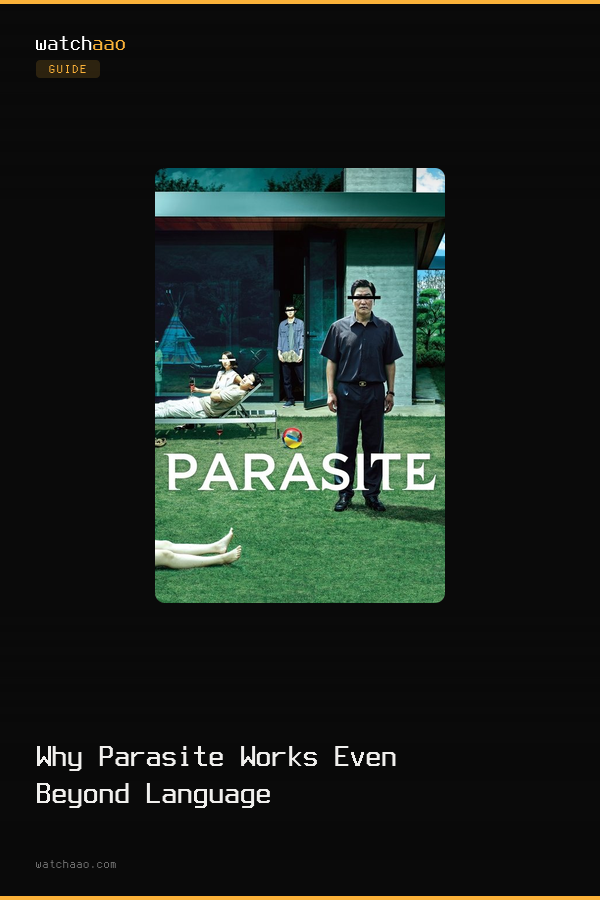
Parasite became the first foreign-language film to win Best Picture at the Academy Awards. The common explanation is political — a shift in academy membership, a cultural moment. The better explanation is simpler: the film does something most films cannot do.
It communicates before it speaks.
The Architecture of Space
The film's class argument is delivered almost entirely through vertical geometry.
The Kim family lives below ground — a semi-basement flat where the view from the window is a strip of pavement and passing feet. The Park family lives on a hill, in a house designed by a celebrated architect, with a garden that is visible from every room. The movement between these spaces is not incidental. It is the film's visual language.
Every scene involving the Kims moving into the Park household is an upward movement. Every moment of their exposure or failure is a downward one. When the rain comes — the event that destroys the Kim family's semi-basement — it is because water flows down. Class, the film argues, works the same way. Not through individual malice but through the direction gravity takes.
Bong Joon-ho does not explain this. He builds it into the physical geography of every shot.
Blocking as Class Anxiety
The film's most precise achievement is its use of blocking to communicate what dialogue would flatten.
In scenes where the Kim family members are performing their false identities for the Parks, Bong stages their bodies in states of controlled tension — close together, aligned in mutual deception, aware of each other in ways the Parks are not. When this tension breaks, it breaks physically, in full shot, and the eruption is legible without translation because we have been watching the compression build for ninety minutes.
The sequence in the living room — when the Parks return unexpectedly and the Kims hide under furniture — is a masterclass in sustained physical comedy that is also sustained physical dread. The audience is watching a spatial problem unfold in real time, and the problem is social class performed as a body under a table.
A viewer who has never seen a Korean film, who cannot read a single subtitle, understands exactly what is at stake in that scene.
Genre as Social Commentary
Parasite moves through comedy, thriller, and tragedy across its runtime, and the transitions are structural rather than tonal accidents.
The first half of the film is a dark comedy. The Kim family is resourceful, funny, and successful in their infiltration. The audience is complicit — we are rooting for them. The comedy works because we recognise the social performance they are executing. Everyone, in some context, is managing an impression.
The genre shift in the second half — into thriller, then horror, then tragedy — is the film's argument about where social performance leads when the system underneath it is not reformed. The comedy was always going to become a tragedy. The film's genre structure makes this inevitable without announcing it.
This is a move that does not require linguistic subtlety. It requires only that you watch what is happening on screen.
The Smell
The film's most quietly devastating element is smell — the thing a camera cannot capture and must represent indirectly.
Mr Park comments on Mr Kim's smell. It is a private comment, overheard. It is the moment when the film reveals the limit of what performance can achieve — that there is a register of class, a physicality, that cannot be disguised by clothing, diction, or competence. The Kims can learn the scripts. They cannot change what they smell like.
The film communicates this through reaction — the way Mr Kim registers having been heard, the way his son registers the same observation later, the way the smell eventually becomes a weapon. All of this is performed. None of it requires translation. The camera reads what the body says before the subtitles arrive.
Related Watchaao Collections
- Best Korean Thriller Movies — Parasite in the tradition it belongs to.
- Oscar Winning Movies Worth Rewatching — the awards context and the films it won against.
- Movies You Cannot Stop Thinking About — for when Parasite is still running in the background.






Community
Join the conversation
Native comments are planned for watchaao. For now, send your thoughts through the upcoming community channels.