

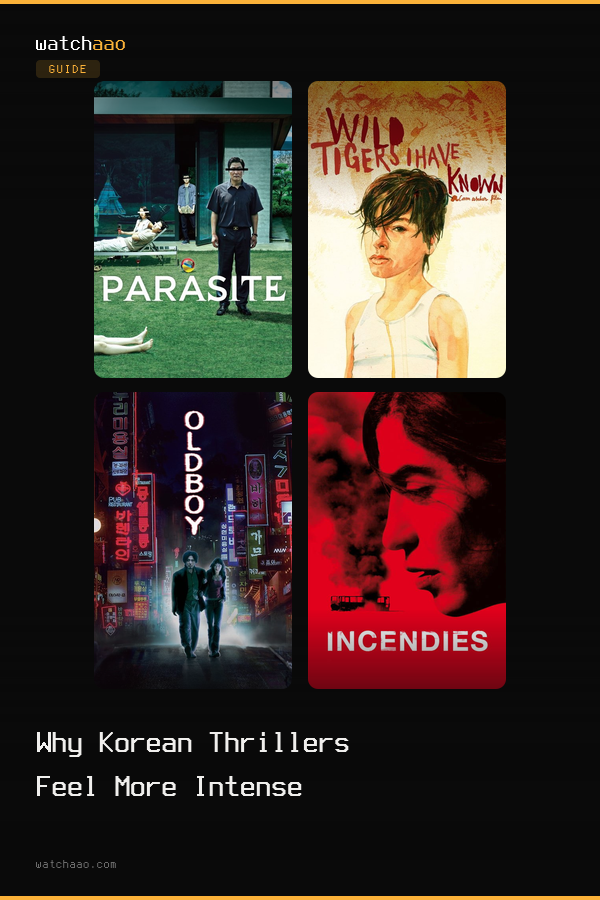
Viewers who watch Korean thrillers after a diet of Hollywood genre films consistently report the same experience: the Korean films hit harder, stay longer, and disturb in ways that are difficult to fully explain. This is not a matter of taste. It is the result of specific structural and cultural choices that Korean cinema makes and Hollywood consistently avoids.
Korean Thrillers Do Not Protect the Protagonist
Hollywood genre films operate on an implicit contract with the audience: the protagonist will probably survive, the moral stakes will be resolved, and the worst things will happen to secondary characters.
Korean thrillers do not honour this contract.
In Memories of Murder, the detectives fail. The killer is never caught. The film ends with the investigator returning to the site of the first murder, decades later, as an ordinary civilian — and then learning, from a child, that someone else visited recently and stood looking at the field. The contract is not just broken; it is shown to have been a fiction. Failure was always possible. The investigation was always going to be conducted by fallible men in an underfunded system.
In I Saw the Devil, the protagonist wins every confrontation and destroys himself in the process. The film is a meticulous deconstruction of the revenge thriller: it delivers everything the genre promises and then shows you what those deliveries actually cost.
When audiences cannot rely on the protagonist being protected, the tension operates differently. Every scene carries genuine risk.
Moral Complexity Is Built Into the Structure, Not Added as Seasoning
Hollywood films often claim moral ambiguity while delivering moral clarity. The protagonist does questionable things, but the film ultimately validates them. The villain is complex, but the film ultimately condemns them.
Korean thrillers build moral complexity into the foundation.
Oldboy's protagonist spends fifteen years planning revenge and achieves it. The revelation in the final act does not undercut his revenge — it makes it something else entirely, something the genre vocabulary cannot accommodate. The film does not tell you what to feel. It puts you in a position where the conventional emotional responses are no longer available.
Parasite does not have a villain. It has people in a system that produces outcomes none of them individually intended. The violence at the end is the product of accumulated social pressure — class resentment, false identity, the fragility of arrangements built on deception. Korean thrillers consistently locate the source of horror in structure rather than individual evil. This is harder to process and harder to dismiss.
Pacing Is Built Around Accumulation, Not Momentum
Hollywood thrillers are built on momentum — continuous forward movement, escalating stakes, accelerating pace toward a climax. The engine keeps running.
Korean thrillers are built on accumulation. They add weight rather than speed. Memories of Murder spends its first hour establishing the incompetence and corruption of its investigation before the real horror of the case becomes visible. The horror lands harder because the ground has been prepared.
This pacing requires more patience from the audience and delivers a different kind of impact. The tension in Korean thrillers often does not come from not knowing what will happen but from feeling the full weight of what is already happening. You know something terrible is coming. You are watching the exact mechanism of its arrival. The dread is precise because the film has taken the time to make it precise.
The Violence Is Consequential
Korean thrillers do not use violence as spectacle. They use it as argument.
The violence in I Saw the Devil is continuous, escalating, and deliberately designed to exhaust the audience's desire for it. By the time the film ends, the revenge has been achieved and the protagonist has destroyed his own humanity in achieving it. The film's violence is the thesis. Each scene of brutality is evidence for the same proposition: that the terms of the revenge thriller are self-defeating.
Oldboy's violence is balletic and exhausting in the same sequence — the corridor fight is aesthetically extraordinary and physically punishing to watch. It does not feel like action cinema. It feels like endurance.
When violence has consequences — physical, psychological, moral — it creates tension rather than releasing it.
Related Watchaao Collections
- Best Korean Thriller Movies — the essential films and where to start.
- Hollywood vs Korean Thrillers: Where Should Beginners Start? — the comparative guide for navigating both traditions.
- Movies You Cannot Stop Thinking About — for when the Korean thriller is still running three days later.








Community
Join the conversation
Native comments are planned for watchaao. For now, send your thoughts through the upcoming community channels.